On a cloudy morning in August, a group of women and children sat in a small urban garden and reflected on hope, intention, progress … and peas.

Broadview residents sit in the new rehabilitated garden with Abbey and Cheyenne.
“Two weeks ago, we were planting seeds of hope – setting intentions and thinking about what we wanted to see come to fruition this coming year,” says Cheyenne Schultz, a therapeutic horticulturalist. “Every time we planted a pea, we set an intention. We’ve been watering them and guess what? Almost every single one of these has grown.”
Sitting in the circle that morning were survivors of domestic violence (DV) who came to Solid Ground’s Broadview Shelter & Transitional Housing for shelter, support, and an opportunity to process and heal from their trauma while launching new lives. Starting this past summer, part of that process for some families has included weekly visits to Broadview’s newly rehabilitated garden, where they spend two hours with their children getting their hands in the dirt, creating art, and observing the progress of the flowers, herbs, and vegetables they’ve planted.
“They love being able to see the transformation of the space, being able to see something grow,” says Kim S., a Broadview DV Children’s Advocate. “Because what can get really frustrating for DV survivors is when you’re here – and you’re having to deal with applying for all these different housing programs – and trying to sort out job applications. The system can be so complicated, and being able to do a simple task of planting a seed and watching it grow and thinking, ‘I did that, I accomplished that’ – it really means something.”
Nature as medicine
Every year, thousands of women in Washington state leave behind everything they know and rely on – support networks, personal belongings, even critical documents like birth certificates and driver’s licenses – in order to escape violent and abusive relationships. With nowhere else to go, many end up homeless, isolated, and vulnerable, often with children to care for.
But at Broadview, around 100 families each year find a safe, secure home along with resources to help them begin new lives, including parenting coaching, youth development programs, financial literacy classes, and opportunities to heal and build connections.
This summer, some residents found an especially meaningful way to connect and heal: weekly therapeutic gardening sessions created in partnership with Rooted Hands Collective. Founders Cheyenne Schultz and Abbey Loos started the nonprofit organization to bring the emerging fields of therapeutic horticulture and eco-therapy to communities that can benefit most from the life-giving power of nature connection.
Cheyenne, a longtime farmer and botanical artist, first sensed the healing potential of plants through farming. “It was one day that I was weeding and attaching negative thoughts to each weed I pulled out of the ground. I felt my stress start to go away,” she recalls. “I thought, ‘There has to be something to this,’ and immediately started researching and discovered the field of therapeutic horticulture. Once I found this field, I knew it was what I wanted to do.” That discovery would eventually grow into Rooted Hands Collective, where she and Abbey now share that same sense of calm and renewal with others.
Cheyenne and Abbey met while working together at Aash Farms in Woodinville and quickly realized they shared a passion for working with people in nature to support their mental health.
Abbey – who’s a graduate student studying clinical mental health counseling, a yoga instructor, and a nature mentor through the Wilderness Awareness School in Duvall – sees mental health through a holistic lens: “Our mind and body are closely connected, and eco-therapy is powerful because it works in the body – smelling fragrant plants, putting your feet on the earth, listening to the sound of birds. It’s an accessible way to practice mindfulness and is naturally regulating because we evolved in relationship with nature.”
Abbey, center, talks with Broadview families while Cheyenne, left, looks on.
Abbey first connected with Solid Ground last year when she volunteered to lead family yoga classes at our Sand Point Housing campus and then saw an opportunity to partner with families at Broadview. Cheyenne and Abbey started by working with Broadview to develop a therapeutic nature-based program to fit their needs.
“There was a space to garden, and we thought it would be a great way to build a sense of belonging and a sense of home – both with the natural environment and with this place – even if they are just passing through,” Abbey says.
Therapeutic horticulture is increasingly being seen as a legitimate and proven treatment for trauma and mental health issues. Recent studies show that even a short period of time spent in natural settings each day can have a measurable effect on a person’s stress hormones.*
“It’s now coming around where nature-based activities are moving into a clinical setting, where people are using them to rehab folks who have had traumatic physical experiences,” Cheyenne says. “It’s working its way into vocational settings, teaching people how to have interpersonal relationships, build autonomy, and feel confident being in groups.”
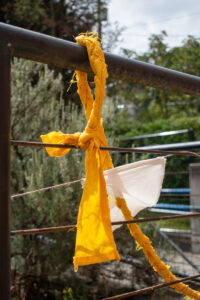
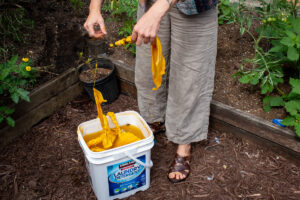
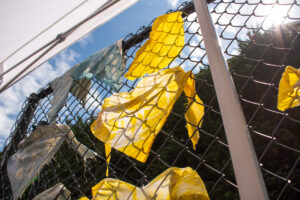
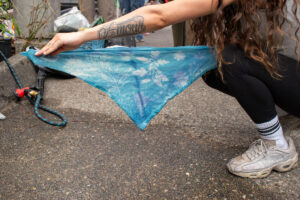
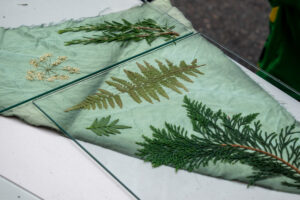
Scarves naturally tie-dyed with turmeric
But before it could provide healing opportunities in a garden setting, Broadview needed a garden. Though the shelter had a few patches of dirt off its parking lot, little was growing there when Abbey and Cheyenne arrived last spring.
“When we came to water the garden beds for the first time, the soil was so dry it wouldn’t hold water,” Abbey says.
“It’s been amazing to see the garden transform and have so many passionate participants who want to work in the space.”
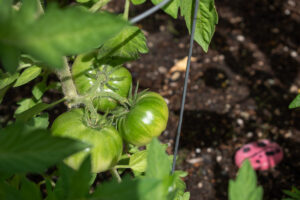
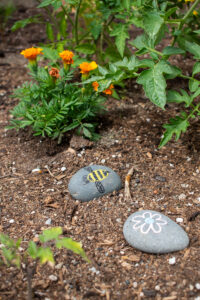
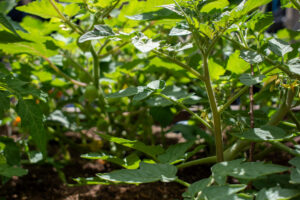
The pair worked with residents over the course of the summer to prepare the soil, lay down compost and mulch, and plant tomatoes, tomatillos, peppers, marigolds, rosemary, sage, ground cherries, and of course, peas. Even they were surprised how eager families were to join them in even the dirtiest work.
“Gardening naturally brings people together. People share memories of the kinds of food they grew when they were younger. They share uses for herbs. It’s very collaborative,” Abbey says.
‘Whatever you choose is going to be beautiful’
The weekly visits with Abbey and Cheyenne aren’t just about keeping up the landscaping. Each session starts with mothers and children sitting together and taking a moment to ground themselves in the space and be present with each other. Then it’s on to a nature-based art project in the garden.
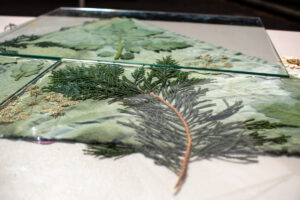
A Broadview mom picks out flowers and leaves from the garden to make solar print.
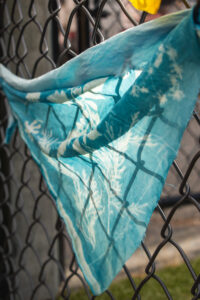
One morning in August, the mothers pulled out white scarves that had been tied into knots and left soaking in turmeric water at the prior week’s session, leaving them with a bright orangey-yellow tie-dye stain. Then they walked around the garden, where they gathered blossoms, herbs, and leaves before transferring the silhouettes of the objects onto a piece of cloth using a chemical process known as solar printing.
“You have to just trust yourself, just grab what feels right,” Cheyenne tells them. “If you’re looking at a leaf, just go for it and know that whatever you choose is going to be beautiful. It’s going to be unique.”
Most importantly, though, everyone is invited to participate in whatever way feels right to them. “We offer many ways to engage and nothing is mandatory, which is key to empowerment and autonomy,” Abbey says.
“We just want them outside with us,” Cheyenne says. “Even just watching someone garden or watching someone do art, you can still reap those benefits. You don’t need to be doing anything specific to feel connected to the environment, so it’s been really beneficial for some people to even just be out there with us.”
‘How far you’ve come’
A solar-printed bandana decorated with items found in the Broadview garden
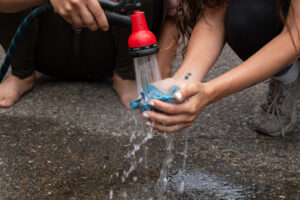
After finishing the prints, the group turns to the garden itself, with small children taking turns watering with a hose as Abbey points out plants they’ve missed. It’s an opportunity for moms and children to work together in the dirt, but Abbey and Cheyenne also set aside time to give their undivided attention to each child for a bit while their mother has a moment to herself in the garden.
For many of the children, the sessions are their first chance to experience the joy of putting their hands in the dirt.
“I love watching the kids get more comfortable getting dirty,” Abbey says. “At first they’re not sure, and then they’re really into it.”
Time in the garden – which barely existed a year ago – became a weekly highlight for some Broadview families this summer.
One of the Broadview kids waters the garden while Abbey watches.
“They love it,” one mom says. “They love the water, and my son was playing last week just in the dirt. It’s crazy, because I’ve never seen him so interested in something.”
Throughout the session, Abbey and Cheyenne point out lessons to be learned by the plants in the garden. One morning, Abbey compared planting and watering seeds to setting intentions and working towards a goal.
“See these little tendrils?” she asks. “They keep grabbing and working their way toward the sunlight. And every small step that you make toward your goals is just like that. Eventually you’re all the way up here and you haven’t even noticed how far you’ve come. All those little moves make a big difference over time. Even if it’s slow, you’re doing it.”
Growing deeper bonds
Broadview staff say the opportunity to work shoulder to shoulder in the dirt with other moms has been naturally disarming, helping to open conversations and deepen connections.
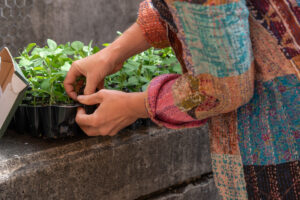
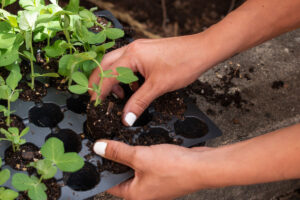
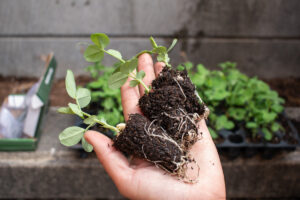
A Broadview mother plants a pea sprout started by the group in an earlier session.
“The nice thing about it is how casual it is, so folks can just talk about what’s going on in their lives,” Kim says.
“Abbey and Cheyenne have such a calming approach, like, ‘Let’s talk about intentions in this space – and also talk about what’s going on outside of this space – and how we can center ourselves while we’re here so life outside can seem a little bit less chaotic.’”
Mothers who regularly come to the gardening sessions this summer say it’s become an important part of their healing journey at Broadview.
“I’d say it gives me peace,” one mom says. “Just hanging out with others is super important, and then also just grounding yourself is super important. And seeing the work that you’ve done, seeing it grow, it’s so beautiful. It’s just so crazy to just to see all of it blooming.”
As summer turns to fall, the garden continues to bloom – not just with vegetables and flowers, but with new confidence and connection. “That’s really what we hope for,” Cheyenne says. “That when people leave here, they carry that sense of growth with them.”
Want to support the healing and growth of families at Broadview? Check out the many Ways to Give through Solid Ground.

* Science Daily: Stressed? Take a 20-minute ‘nature pill’, April 4, 2019
Photos by Clarissa Magdich
Leave a Comment